Facelifts for Men: How they Differ & What to Expect

At the Mandell-Brown Plastic Surgery Center, nearly 25% of our facelift patients are men—and that number continues to grow. Triple board-certified cosmetic surgeon Dr. Mark Mandell-Brown has performed facelifts on male patients for over 30 years, and he believes that a facelift for men is not a women’s procedure adapted for a different patient. Rather, it requires a different surgical mindset from the start.
Why Men Age Differently, and Why That Matters Surgically
Men and women both lose collagen, develop jowls, and experience skin laxity along the jawline and neck as they age. But the male face presents its own set of surgical considerations that have to be accounted for from the moment planning begins:
Thicker skin and stronger musculature
Men generally have thicker skin and denser facial musculature than women. This can work in a man’s favor, as thicker skin tends to show results well, but it also requires a more precise surgical touch when placing and closing incisions.
Increased vascularity means a different recovery
Male skin has greater vascularity than female skin, meaning more blood supply runs close to the surface. This doesn’t significantly change the surgical technique itself, but it does mean that male patients typically experience more bruising and swelling during recovery than women. This is worth knowing going into the procedure—not because it changes the outcome, but because it shapes what the first week or two looks like. Managing those expectations honestly is part of how Dr. Mandell-Brown and his team prepare every patient.
Facial hair changes the entire surgical landscape
Beard growth is one of the most significant variables in male facelift surgery, and it directly influences where incisions can and cannot be placed. A scar in the wrong location on a man’s face isn’t just a cosmetic issue, it can cause hair to grow in the wrong place—permanently.
Different aesthetic goals
Women often seek lifted cheeks and a softened jawline. Men, by contrast, typically want to maintain their angular, defined features—a strong jaw, a sharp neckline, a face that looks energetic and firm rather than dramatically altered. The goal is never feminization; it’s refinement. Dr. Mandell-Brown’s Natural Look™ philosophy applies directly here: you should look like a better version of yourself, not a different person.
The Adam’s Apple
Here’s something most men don’t know going into a consultation: the position of your thyroid cartilage—your Adam’s Apple—relative to your chin has a real influence on how dramatic your result will be. When the Adam’s Apple sits further back, the angle of the neck is naturally sharper, and the facelift can produce a more striking improvement. When it sits more forward, the improvement will be more subtle. This is one of the honest conversations Dr. Mandell-Brown has with every male patient in order to set realistic expectations based on your unique anatomy.
Men’s Facelift Incisions
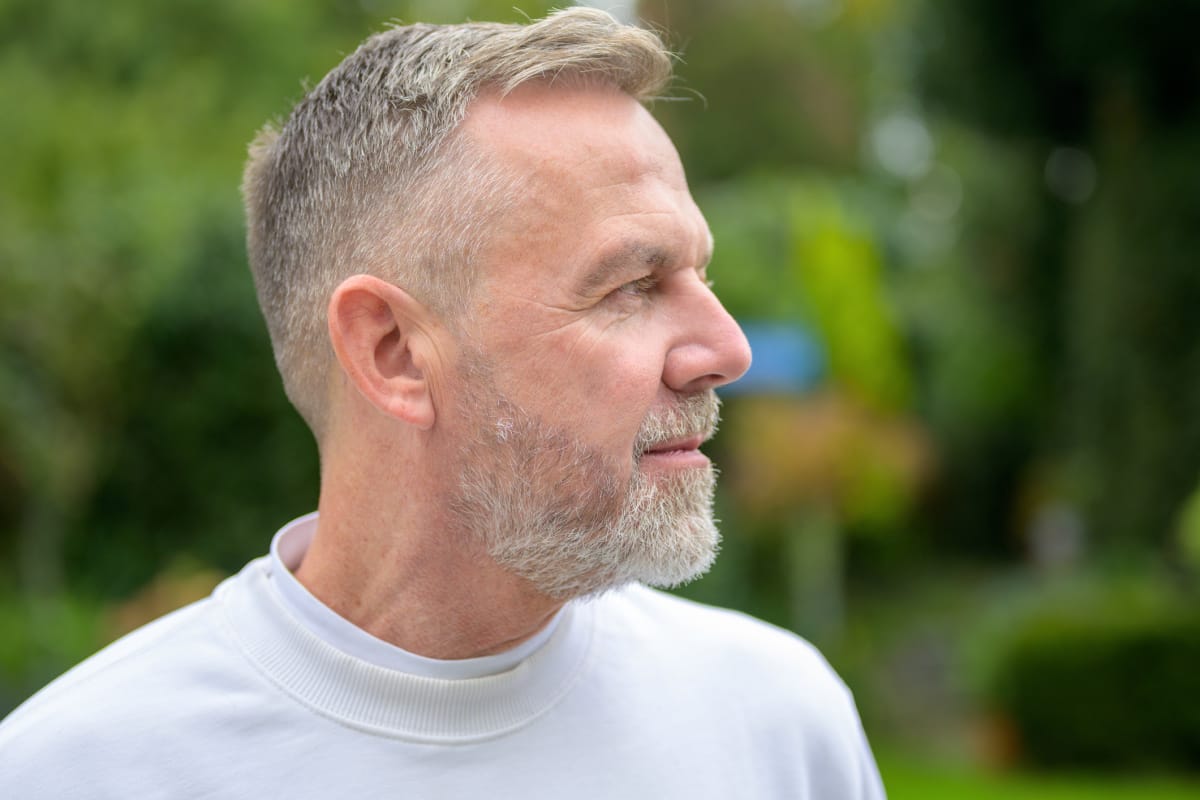
Incision placement is one of the most important, and most nuanced, decisions in a male facelift, and it’s worth understanding why. Dr. Mandell-Brown generally favors placing the incision behind the tragus. A scar in front of the tragus is one of the more visible telltale signs of a facelift in men.
The tradeoff is that when the incision is placed behind the tragus, beard-bearing skin can advance slightly into an area that is normally hairless. That means some male patients will need to shave a little closer to the ear post-surgery, or consider a few sessions of laser hair removal to address any unwanted hair growth in that zone. For many men, this is a reasonable and manageable adjustment—and a far better outcome than a visible scar.
This is the kind of specific, practical conversation Dr. Mandell-Brown has during every male patient consultation. That being said, there is no single right answer for every man, and the best approach depends on your beard pattern, hairline, and how much natural coverage you have around the ear area.
What a Facelift for Men Actually Addresses
Men considering a facelift are typically most bothered by the jaw and neck—the jowling along the jawline, loose skin beneath the chin, and a neck that has lost its definition. The midface (cheeks) tends to be less of a concern for men than it is for women.
A facelift addresses these concerns by using liposuction to remove excess fatty tissue, tightening the underlying muscle layer, and then removing and repositioning the excess skin. This multi-layer approach—rather than simply pulling the skin tighter—is what produces a natural result rather than an overdone one. The technique is the same whether you’re a man or a woman; what changes is the surgical plan around it.
Depending on your anatomy and goals, Dr. Mandell-Brown may recommend a quick facelift for earlier signs of aging, a mid facelift for moderate jowling in the cheek and jaw area, or a full facelift for more significant laxity across the lower face and neck. He’ll discuss which approach makes sense for your specific concerns at your consultation—rather than defaulting to one technique for everyone.
Recovery: What Men Should Realistically Expect
Recovery from a facelift is largely similar for men and women, with a few practical differences worth knowing about.
The first few days involve some tightness and mild discomfort, both of which are manageable with medication. Most patients describe the sensation as tightness more than actual pain. Because male skin has a high degree of vascularity, men should expect bruising and swelling—this is normal, and it resolves. Rest and keeping the head elevated are important during this period to minimize swelling and promote healing.
By the end of the first week, most men are ready to return to work. If you schedule your procedure on a Friday, plan to take the following five working days off. Dr. Mandell-Brown is straightforward about this: be cautious of any surgeon who promises a four-day recovery as a guarantee. Everyone heals on their own timeline, and an honest surgeon gives you a realistic range rather than the most convenient answer.
If you have a beard, you’ll also need to follow specific guidance around shaving near the incision sites while they heal. Dr. Mandell-Brown and his team will walk you through exactly what to expect in that regard.
To minimize bruising and support the healing process, Dr. Mandell-Brown uses IV sedation rather than general anesthesia, recommends Vitamin B and C supplementation before and after surgery, and applies customized compression dressings post-operatively. In select patients, he also uses autologous platelet gel—a technique that draws on the patient’s own clotting factors to reduce bruising further.
Procedures Men Often Combine With a Facelift
Because a facelift focuses on the mid and lower face, many patients choose to add complementary procedures for a more complete result. The most common pairing is eyelid surgery, since once the lower face is tightened, heavy or sagging upper eyelids and under-eye bags tend to become more noticeable by comparison. Injectables like Botox or Dysport can address forehead lines and crow’s feet that surgery doesn’t treat, helping to maintain the result over time.
Combining procedures isn’t always necessary—and Dr. Mandell-Brown will never recommend more than what’s genuinely appropriate for your anatomy and goals. But when multiple areas would benefit, addressing them together means one recovery period and a more cohesive result overall.
Why Choose Dr. Mandell-Brown for a Male Facelift in Cincinnati
Dr. Mark Mandell-Brown is one of only 100 cosmetic surgeons in the country with triple board certification in Facial Plastic Surgery, Body Cosmetic Surgery, and Head & Neck Surgery. He has been performing facelifts for over 30 years, has authored two facelift textbook chapters published for other cosmetic and plastic surgeons, and has lectured nationally on facial rejuvenation techniques. His AAAHC-accredited surgery center in Cincinnati offers hospital-quality care in a private, comfortable setting.
His philosophy has always been the same: patients should look rested and rejuvenated—not overdone, and not different. For male patients especially, that means a result that quietly improves the face without ever announcing itself.
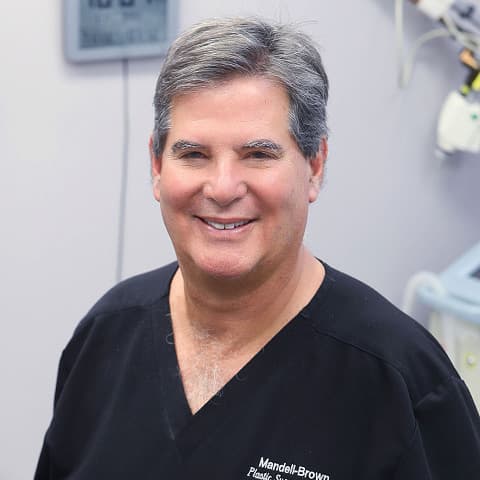
Dr. Mark Mandell-Brown
Dr. Mandell Brown is a nationally recognized, triple board-certified cosmetic surgeon with over 30 years of experience performing facial, breast, and body procedures. Known for his Natural Look™ cosmetic surgery results, Dr. Mandell-Brown has the credentials and aesthetic eye to precisely tailor your procedure and safely achieve the results you desire.


Ready to find out what’s possible for you? Call us at (513) 984-4700 (Cincinnati) or (937) 260-4405 (Springboro) to schedule a personal consultation with Dr. Mandell-Brown. We serve patients throughout Cincinnati, Springboro, and Dayton, Ohio.