4 Trending Facelift Buzzwords to Avoid

If you’ve spent any time researching facelift surgery online, you have probably encountered a dizzying array of terms: the ponytail lift, the cat eye lift, the lunchtime lift, the liquid facelift. They may sound distinct—even revolutionary. Some of them are trademarked. Many of them have celebrity endorsements.
Unfortunately, most of them are the social media flavor of the month.
Top Cincinnati facelift surgeon Dr. Mark Mandell-Brown has been performing facelifts for over 30 years, and he has watched the same underlying surgical concepts get repackaged, renamed, and relaunched more times than he can count. His perspective is straightforward: the name of a procedure tells you almost nothing. What matters is whether your surgeon has the skill and experience to assess your specific anatomy and choose the approach that will actually get you the result you’re looking for.
Here, he breaks down four of the most searched facelift buzzwords circulating online right now, and what you should know before asking a cosmetic surgeon for them by name.
1. The “Ponytail Lift”
Of all the trending facelift names, the ponytail lift may be the most aggressively marketed. The name comes from the idea that pulling your hair into a tight, high ponytail temporarily lifts the skin of the midface and cheeks—and the procedure promises to replicate that effect surgically, with minimal incisions and little downtime.
Here’s what the name doesn’t tell you: the concept of lifting facial tissues upward is not new, nor is it revolutionary. Surgeons have been achieving exactly this effect for a very, very long time, and the core principles behind it appear in textbooks that predate social media by decades. What the ponytail lift actually describes is typically a less invasive facelift that focuses on the midface and cheeks via smaller incisions hidden in the hairline. (The neck and jawline are generally not addressed.)
When it comes to trending surgeries, there is no standard definition—so results, technique, and longevity vary enormously.
For some patients, this limited scope is appropriate. For many others, particularly those with jowling or significant neck laxity, a more comprehensive approach will be necessary to achieve a balanced result.
Further, there is no standardized medical definition of a “ponytail lift,” and one surgeon’s version may differ significantly from another’s. When you see the term, what you are most likely looking at is a marketing label, not a distinct surgical technique.
2. The “Cat Eye” or “Fox Eye” Lift
The cat eye lift—sometimes called a fox eye lift—became a social media phenomenon after high-profile celebrities and influencers began sporting an elongated, almond-shaped eye appearance. The look went viral, and demand for the procedure followed.
A few things worth knowing. First, the cat eye lift is not a facelift, nor is it even adjacent to a facelift. What it actually refers to is a lifting procedure targeting the outer corners of the eyes, which may involve anything from sutures and threads to a surgical brow or eyelid lift depending on the provider. Results, technique, and longevity vary enormously because there is no standard definition.
Second, and more importantly: aesthetic trends change. What looks striking on a filtered photo at a particular moment in time does not always translate to a natural, enduring result on a real face. Dr. Mandell-Brown’s philosophy has always been to help patients look better, not different, and that means approaching the eye area with a personalized technique for what suits a patient’s anatomy, rather than chasing a popular look from Instagram.
If you have concerns about the upper eyelids, lower eyelids, or brow position, a conversation about eyelid surgery or a brow lift is worth having, but it should be grounded in your actual anatomy and goals rather than a trending aesthetic.
3. The “Lunchtime Facelift”
The lunchtime facelift, sometimes called the lunch break facelift or weekend facelift, is exactly what it sounds like: the promise that you can have facelift surgery and be back to your normal life within hours, or at most a day or two. It’s one of the most appealing ideas in cosmetic surgery marketing, and one of the most misleading.
In reality, a facelift is surgery. Even the most limited facelift options require real recovery time, and any surgeon who tells you otherwise is prioritizing a sale over your safety and your result. Swelling, bruising, and the need for proper healing don’t disappear because a procedure has been given a breezy name.
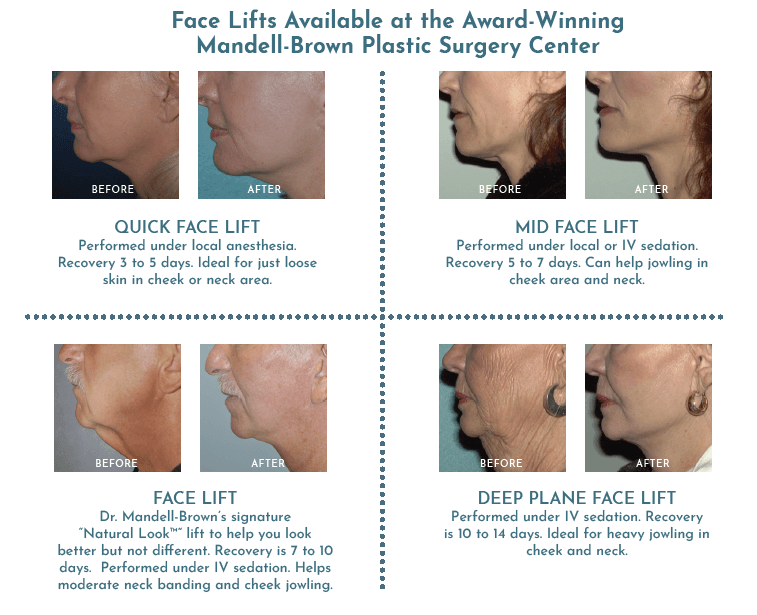
Dr. Mandell-Brown does offer a Quick Facelift, and it genuinely is his fastest facelift option. Performed under local anesthesia in about one hour, it addresses early signs of aging in the cheek and jawline area, and most patients are ready to return to work within about a week, with recovery running three to seven days. For the right candidate with mild, early aging changes, it can be an excellent option.
But three to seven days is not a lunch break; it’s not a weekend. It still requires planning, preparation, and appropriate post-operative care. The Quick Facelift is fast because it’s the right procedure for a certain patient, not because facelift surgery has somehow become consequence-free. If a surgeon is selling you on how quickly you will bounce back, ask what you are getting in return for that speed, and whether it is actually the right procedure for what you’re trying to address.
4. The “Liquid Facelift”
The “liquid facelift” isn’t surgery at all, but a combination of injectable treatments, typically dermal fillers and Botox or similar neuromodulators, strategically placed to add volume and smooth wrinkles. Calling it a “facelift” is a significant stretch.
That’s not to say injectables are not a valuable treatment option. Treatments with Botox & Dysport, Restylane, Sculptra, and Radiesse can do a great deal for patients with early signs of aging—smoothing dynamic lines, restoring lost volume in the cheeks and temples, and enhancing surgical results over time. At the Mandell-Brown Plastic Surgery Center, we offer a full range of these treatments and recommend them regularly.
What injectables cannot do is lift and reposition sagging tissue. There is no vertical “lift” occurring with fillers, because volume is being added—tissues are not being repositioned. For patients with meaningful skin laxity, jowling, or a loss of jawline definition, a liquid facelift will fill the face without addressing the structural changes that are actually causing the problem. In some cases, adding volume to a face that also needs lifting can make signs of aging appear more pronounced, not less.
What to Ask Your Cosmetic Surgeon Instead
Rather than walking into a consultation asking for a specific named procedure, consider sharing your concerns about your appearance, and asking your surgeon these questions:
- Based on my anatomy and goals, what approach do you recommend, and why?
- What areas will this address, and what will it not address?
- What does recovery look like for this type of procedure?
- Can I see before-and-after photos of patients with similar concerns to mine?
A surgeon who gives clear, honest answers to those questions, and who tailors the conversation to your face rather than to a trending technique, is the kind of surgeon worth trusting with the result.
Dr. Mark Mandell-Brown is triple board-certified in Facial Plastic Surgery, Body Cosmetic Surgery, and Head & Neck Surgery, with over 30 years of facelift experience and a published textbook chapter on facelift technique written for other surgeons. His AAAHC-accredited surgery center serves patients throughout Cincinnati, Springboro, and Dayton, Ohio.
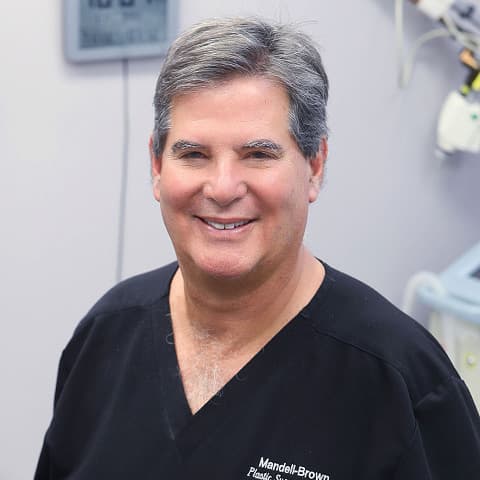
Dr. Mark Mandell-Brown
Dr. Mandell Brown is a nationally recognized, triple board-certified cosmetic surgeon with over 30 years of experience performing facial, breast, and body procedures. Known for his Natural Look™ cosmetic surgery results, Dr. Mandell-Brown has the credentials and aesthetic eye to precisely tailor your procedure and safely achieve the results you desire.
Ready to have an honest conversation about what facelift surgery can do for you? Call (513) 984-4700 (Cincinnati) or (937) 260-4405 (Springboro) to schedule a consultation with Dr. Mandell-Brown.